
For more information and resources, see the tools linked at the bottom of this page.
MEASURING WHAT MATTERS
High quality WASH responses are critical to saving lives, preventing harm and supporting a life with dignity. The humanitarian community invests significant resources in providing assistance that is not only technically effective, but in line with fundamental humanitarian principles.
However, evaluations repeatedly highlight reoccurring technical issues, and it is common to hear from those affected by crisis that aid does not meet their priority needs in a safe and dignified way.
WHAT DO WE MEAN BY ‘QUALITY’?
Quality is a broad term that covers many different aspects of performance and is relevant to all stages of the humanitarian programme cycle.
The AQA Initiative uses the following criteria to characterise a quality humanitarian response:
- ACHIEVES OBJECTIVES. The response is effective at achieving objectives.
- AVOIDS DOING HARM. The response avoids doing harm and promotes the safety of people affected by crisis and others engaging with the response.
- SATISFIES THE COMMUNITY. People affected by crisis are satisfied that the response meets their priority needs in an appropriate and timely way.
There is no absolute level of quality. Minimum standards for quality must be adapted to fit the context and agreed collectively between partners, based on consultation with those affected.
WHY?
- Existing monitoring and evaluation approaches are limited. Whilst they collect a lot of data, they focus on tracking activities rather than understanding what is working for whom.
- Reporting requirements are often prioritised, using vanity metrics that evidence our strengths but fail to address our weaknesses.
- Opportunities for improvement are being missed, resulting in programmes that are falling short in terms of quality.
Response metrics should balance our accountability to both donors and those affected by crisis.
VANITY METRICS VS ACTIONABLE METRICS
WHAT’S THE DIFFERENCE?
Data collection and analysis are time consuming; we must prioritise metrics that can help us make better decisions. Most of the data currently available highlights achievements but doesn’t show the whole picture.
| VANITY METRICS: | ACTIONABLE METRICS: |
| Headline numbers that focus on activities completed, but do not capture information that indicates where we need to improve. Examples: – Number of people reached – Number of latrines built – Number of hygiene kits supplied – Number of WASH committees established | Information that can be used to understand whether activities are working and leads to specific improvements. Examples: – % of people accessing safe water – % of people using latrines – % of people satisfied with the kits – % of WASH committees with women in leadership positions |
WHAT NEEDS TO CHANGE?
- Humanitarian crises are complex and chaotic – we need to collectively set clear standards for quality and hold ourselves accountable.
- We must engage with those we seek to help, to understand our work from their perspective, measuring ourselves against their expectations and adapting our programmes accordingly.
- We need metrics that show where to improve so that course corrections can be made in time to be effective.
Monitoring what matters will lead to programmes that have more meaningful impact.
HOW TO IMPLEMENT CHANGE
Delivering high-quality programmes that fulfil our commitment to be accountable to those affected by crisis requires a change in the way we collectively monitor and manage humanitarian responses. The AQA Initiative aims to equip the WASH sector with the tools and approaches required to focus on what is important, to continuously adapt to changing circumstances, and ultimately remodel monitoring systems to start measuring what matters.
THE AQA APPROACH
The objective is to empower partners with the information needed to deliver high quality responses by measuring what matter, whilst emphasising the voices of those affected by crisis.
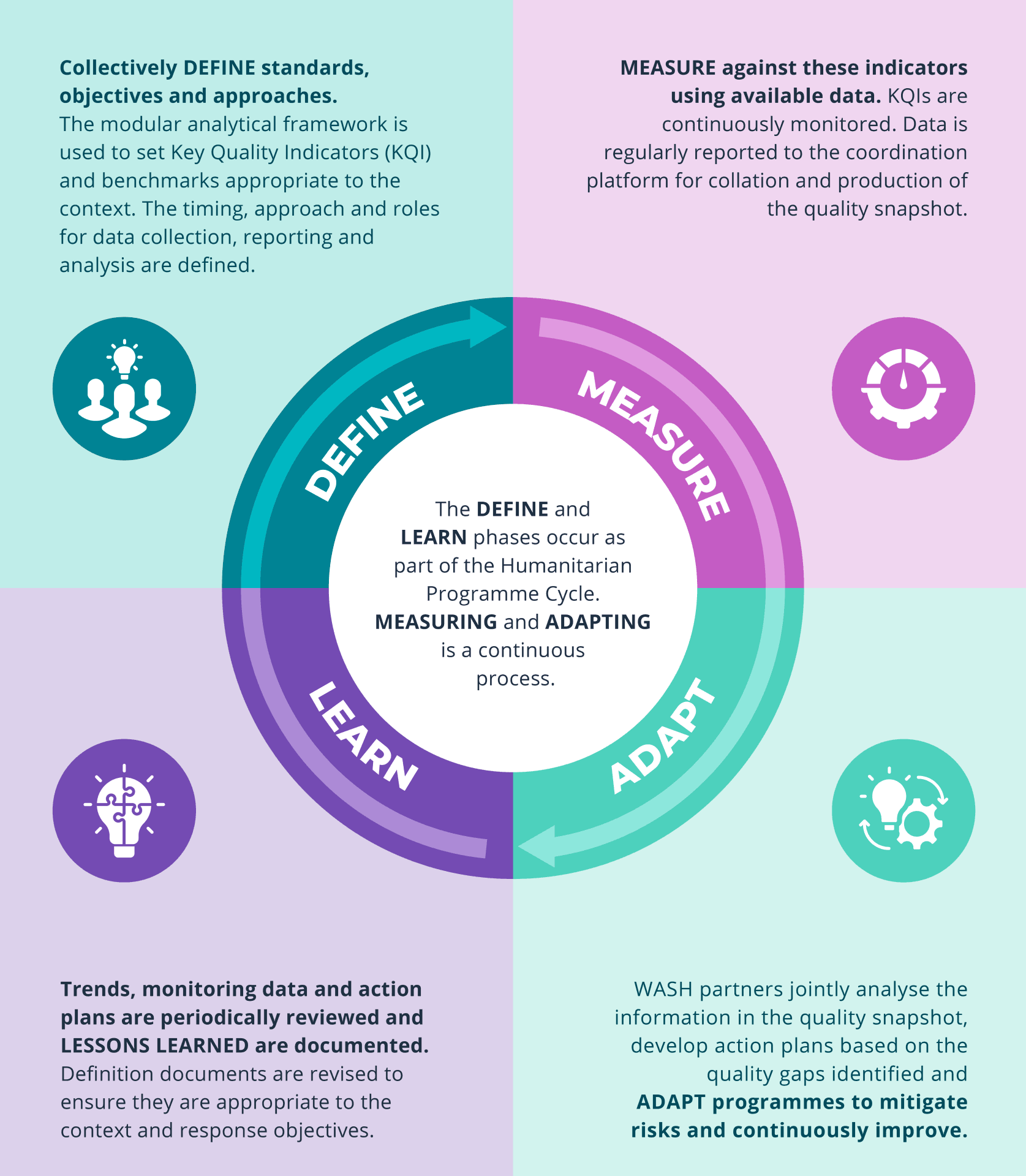
STEP-BY-STEP PROCESS
The process can be implemented by following four key steps – these are sumarized below and outlined in further detail in the AQA Guidance Note.
WHAT ARE THE TOOLS?
The Global WASH Cluster Coordination Toolkit site linked above contains comprehensive collection of resources designed to support the implementation of AQA.
- GUIDANCE NOTE – step-by-step process followed by coordination platforms to collectively implement the AQA approach. Available in English, French, Arabic, Spanish, and Portuguese on the Toolkit site linked above.
- MODULAR ANALYTICAL FRAMEWORK – flexible tool that provides WASH standards, indicators and monitoring approaches. Available in English, French, Arabic, Spanish, and Portuguese on the Toolkit site linked above.
- TOOLBOX – partners onboarding documents, key quality indicators, reporting tools, quality snapshots, partner process surveys, analysis and action plans, monitoring frameworks, and top tips. Accessible at the above link by clicking ‘Key Guidance and Tools’, then ‘Toolbox’.
This online training course is self-paced and available in English and French on the UNICEF Agora platform.