
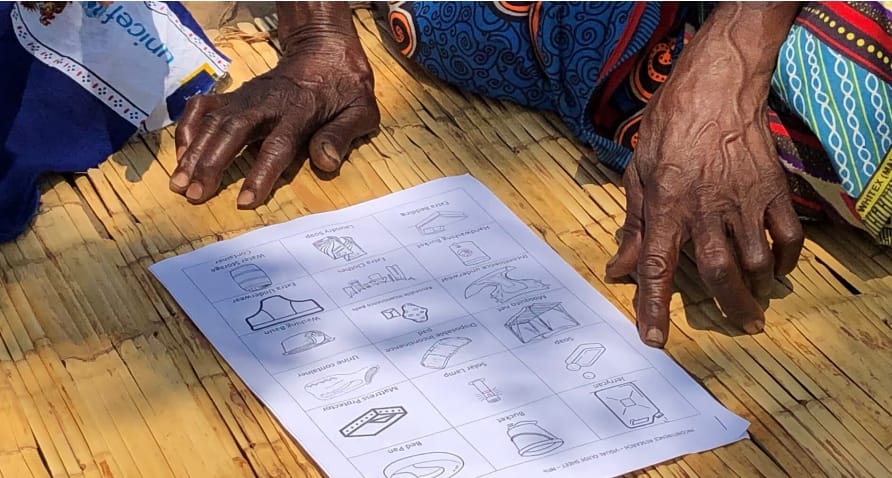
In humanitarian crises, people living with incontinence and their caregivers often face additional barriers to dignity and care. Our approach focuses on giving them greater control over the dignified management of incontinence, while strengthening the support provided by WASH and other humanitarian actors.
Incontinence is a loss of control of urination, defecation or both. It is a condition that is thought to affect anywhere between 1-39% of men and 25-45% of women in humanitarian contexts, although there is not reliable data available to estimate the true figures (Rosato Scott, 2019). Incontinence can happen to anyone, at any age, and for several reasons, however, humanitarian contexts can exacerbate some of the causes of incontinence:
- Lack of access to medical care, meaning treatment for existing conditions, including incontinence is missed or unavailable
- Trauma and stress, known to increase incontinence, including in older children and adolescents
- Lack of support for expectant and new mothers
- Increased cases of gender-based violence
- Lack of access to safe, comfortable and accessible toilet facilities which may increase cases of social incontinence, where a person is unable to use a latrine or access in time, resulting in self-soiling
Since 2019, Oxfam, HelpAge and the Malawi Network of Older People’s Associations (MANEPO) have been undertaking research into the needs of people with incontinence in humanitarian contexts.
From 2019 – 2021, research took place in Gambella, Ethiopia, with South Sudanese Refugees, and in Blantyre, Malawi, with communities affected by cyclone Idai. The objectives of this research were:
- To investigate how the WASH sector can better engage with and support people with incontinence with linkages across sectors, such as health, protection, age, disability and gender.
- To be a catalyst to bring a focus on the needs and priorities of people with incontinence and the importance of engaging with them.
- To understand the coping mechanisms of people with incontinence – learning from how people are managing already.
The findings from this research are summarised in this 10-minute presentation, prepared for the Emergency Environmental Health Forum:
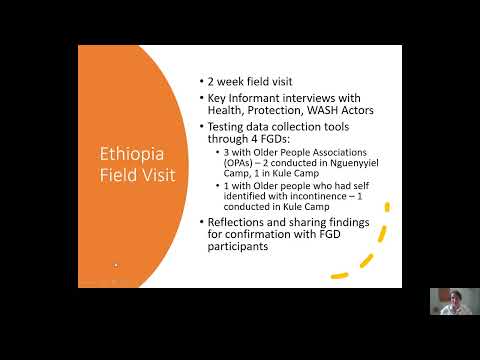
In 2022, Oxfam, HelpAge and MANEPO sought to build upon the findings of this research to take action on the recommendations put forward by people with incontinence. For this project, the team worked with 10 different countries to:
- Discover how older people and their caregivers can be best supported to manage their incontinence within their household settings, in emergency contexts.
- Improve understanding of incontinence amongst humanitarian professionals, both in terms of recording the scale and severity of incontinence, and in terms of implementing support for people with incontinence.
- Understand from older people their preferences, challenges and suggestions for how incontinence products can be used in humanitarian contexts, to better inform selection of these products.
The findings from this extensive research are summarised in this 10-minute presentation, prepared for the Emergency Environmental Health Forum:

This research led to the development of a number of tools that can support humanitarian actors in understanding incontinence, and supporting people with access to appropriate incontinence products, referrals and planning to manage incontinence within their own home. These include:
- A Home-Based Care Package for incontinence support << Hyperlink to page in side panel>>
- A training package for humanitarian workers, exploring the topic of incontinence and ways to support those with incontinence in emergency contexts << Hyperlink to page in side panel>>
- Tools to undertake market assessment for available incontinence products, and to undertake post-distribution monitoring to improve product support for people with incontinence << Hyperlink to page in side panel>>
- Survey questions for needs assessments and household surveys that can support in better understanding incontinence needs and prevalence << Hyperlink to page in side panel>>
Co-created by MANEPO, older people with incontinence and nurses from the Malawi Ministry of Health, the Home-Based Care Package for incontinence is a practical tool kit that can be used by people with incontinence to create strategies to manage this in their own home. The toolkit has been tested in Malawi, Tanzania and Venezuela, and since its creation, has been adopted by the Ministry of Health in Malawi as a core package for Community Health Workers.
Toolkit for Home-Based Incontinence Case
Translations into French, Spanish, Arabic, Swahili and Chichewa will be available here soon.
Jointly developed by Oxfam, ReGIG, and University of Western Australia, this one-day training for humanitarian workers draws on findings from three Humanitarian Innovation Fund (HIF) funded projects looking at different types of incontinence in emergency and fragile settings.
The training package has been tested in 9 different countries and has been adapted to be facilitated online or in person. These materials are freely available for any organisations or individuals to download, explore and use to increase understanding of incontinence in humanitarian settings. If you need any guidance in facilitating the materials, please contact: michelle.farrington@oxfam.org
In person training materials: Coming Soon!
Online training materials: Coming Soon!
Translations of all packages into French, Spanish and Arabic will be available here soon.
In 2026, we will be launching a self-directed online course to explore the topic of incontinence. Stay tuned for more details coming soon!
To better support humanitarian actors in understanding the prevalence of incontinence, and the needs of those who have the condition, Oxfam, HelpAge and MANEPO tested different assessment questions, designed to be included in initial needs assessments or household surveys.
The responses to these questions can support to factor incontinence needs into programme and budget planning, and to better support people with incontinence with the right types of support.
Incontinence Survey Questions: Coming Soon!
Translations of survey questions into French, Spanish and Arabic will be available here soon.
These tools can be used to understand which products are available in local markets that can support people with incontinence, and to hear in depth feedback from users about distributed products. Post-Distribution Monitoring for incontinence products is particularly important, given that users’ needs may change over time and blanket distributions or one off distributions will likely not meet all users’ needs.
Incontinence Product Market Assessment Tool: Coming Soon!
Post Distribution Monitoring for Incontinence Products: Coming Soon!
Translations of survey questions into French, Spanish and Arabic will be available here soon.
Join our community of practice for incontinence in low- and middle-income settings!
This community of practice is a space for practitioners of multiple disciplines to share and stay connected on developments in incontinence research and response. The group is active over email, and we welcome new members who would like to share their examples, ask questions and connect with others working on this topic.
To join the group, email: lmic-incontinence+owners@googlegroups.com