
This technical briefing note looks at design, construction, operation and maintenance for selecting ‘Pipeline Extension from Wellhead to the suction Hand Pumps” installed offsite in different scenarios except for the first phase response.
Inspiration
Where the clean water scarcity is acute and sweet water aquifer is not readily available right in the villages or nearby, but there are few possible pockets (e.g. along with irrigation canal) where sweet water is flowing round the year and can be found in closer by areas. Shallow boreholes can be sunk beside or below the irrigation channel to exploit the freshwater which infiltrates from the irrigation channel into the ground.
The idea of adding surface laid extension pipes to the rising main pipe from the bore hole which is connected to a suction hand pump installed at an offsite location at a distance, would enable the provision of adequate and safe water to the targeted community. This also reduces travel distance and water collection time primarily for targeted beneficiaries, especially adolescent girls had to travel long distances (not safe) to collect sweet water from these canals spending 3-4 hours daily.
Design
Water consumptions in rural areas are often limited to domestic uses, i.e. drinking, cooking, cleaning, washing and bathing. This single system can provide adequate and safe drinking and cooking water for up to 140 or more individuals.
Hand pump technology is known as affordable, acceptable by all, easy to operate & maintain, comparatively low-cost and sustainable water supply option.
The borehole is drilled at a suitable aquifer location. The system works more effective on the shallow wells, but the lessons learnt reveal that the system is very much dependent on the hydraulic grid line (HGL) between pumping and delivery sites, the pumping capacity of the local pumps and the length of pipeline in variable or flat terrain.
This technology works on suction lift pumps and is feasible up to 7m depth of static (standing) ground water level condition. It can produce 0.3 litres per second of clean water with a depth of 3-4m of static (standing) ground water level.
This concept is only feasible where suitable shallow aquifer is available within easy reach of the target village locations, furthermore the successful system would depend on:
- Successful construction of a borehole at suitable aquifer depth and safe location
- Installation of right blind pipes to allow effortless flow of ground water to the well
- Has appropriate gravel packing that minimizes entry of sediments and sand particles
- The connection and placement of extension pipe (lead line) and the trench excavation should be shortest possible straight lines
The complete technology consists of major five components such as –
The borehole is drilled on a suitable aquifer depth within a reachable distance of 500m to 1,500m from the targeted dwelling/ beneficiaries. The bore hole should have appropriate gravel packing
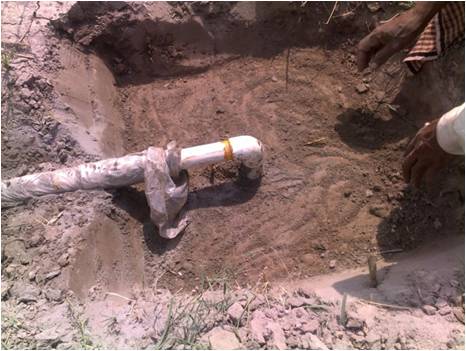
this act like a medium that minimizes the entry of sediments and sand particles.
Skilled labours are required for the drilling and construction of quality borehole. Local skilled labour are always preferred (if available) as they are well aware of the local context.
The borehole assembly is equipped with PVC pipes that are lowered into it. e.g. The traditional hand pump practise in Pakistan is normally using 1.5 inch dia PVC pipes as rising main and filters.
A non-return valve normally functions to allow the water to flow in only one direction, and stops the water from flowing in the opposite direction. The non-return valve is placed in-between the top of the rising main and the extension pipeline to ensure the water pressure is intact in the system.
The extension pipeline is placed in-between well pipe and pump head. One end of the extension pipeline is connected to the wellhead through a non-return valve and the other end is connected
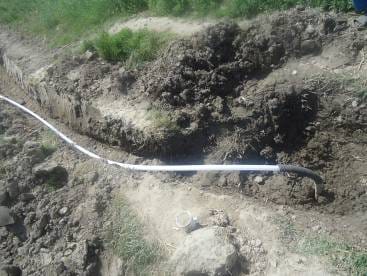
to the bottom of the hand pump. A 12 inch wide and 12-24 inch deep (depending on the local situation) trench is dug from well pipe to pump head where the extension pipelines are laid & buried with soil. Un-skilled labour can be used to perform this work with close supervision and monitoring of a technically skilled person.
Calculations, using the Darcy Weisbach equation have indicated the following possible length of extension pipe (leadline) for 1.25” and 1.5” diameter pipes for different groundwater level depths, assuming a 7m suction capacity, a flow rate of 0.25 l/s and a water temperature of 20°C, and assuming that there is no difference in elevation between the two ends of the horizontal pipeline but allowing for 0.92m (3’) for the height of the hand pump.
Friction losses are calculated using the Hazen-Williams friction loss equation
| GW level | Max length for 1.25” pipe | Max length for 1.5” pipe | |||
| m | Ft | m | ft | m | ft |
| 1.83 | 6 | 410 | 1345 | 1070 | 3510 |
| 2.74 | 9 | 325 | 1066 | 830 | 2723 |
| 3.66 | 12 | 265 | 869 | 625 | 2051 |
| 4.57 | 15 | 180 | 591 | 415 | 1362 |
| 5.18 | 17 | 110 | 361 | 290 | 951 |
Hand pump head The fulcrum in Suction hand pump causes the piston rod to go up as the hand is pushed down, thus taking with it the piston and its rings. This in turn causes a check valve, often referred to as a foot valve, at the bottom of the pump to open and draw water. When the piston goes down, the pressure makes the check valve to close, thus trapping the water above the piston. This cycle repeats itself for as long as the hand pump is in use.

Extension pipelines are connected to the bottom of the suction Handpump head through a 1-2 feet long GI pipe. The entire pump head is placed on top of the ground level while only 3 feet of the hand pump is exposed to the surface. E.g. in Pakistan and Bangladesh context the traditional cast iron pump head are widely used.
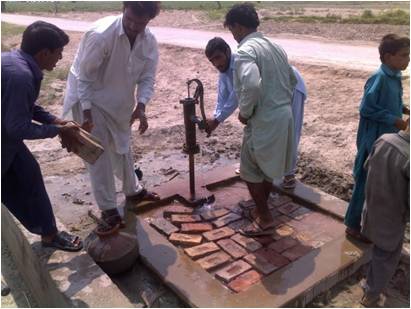
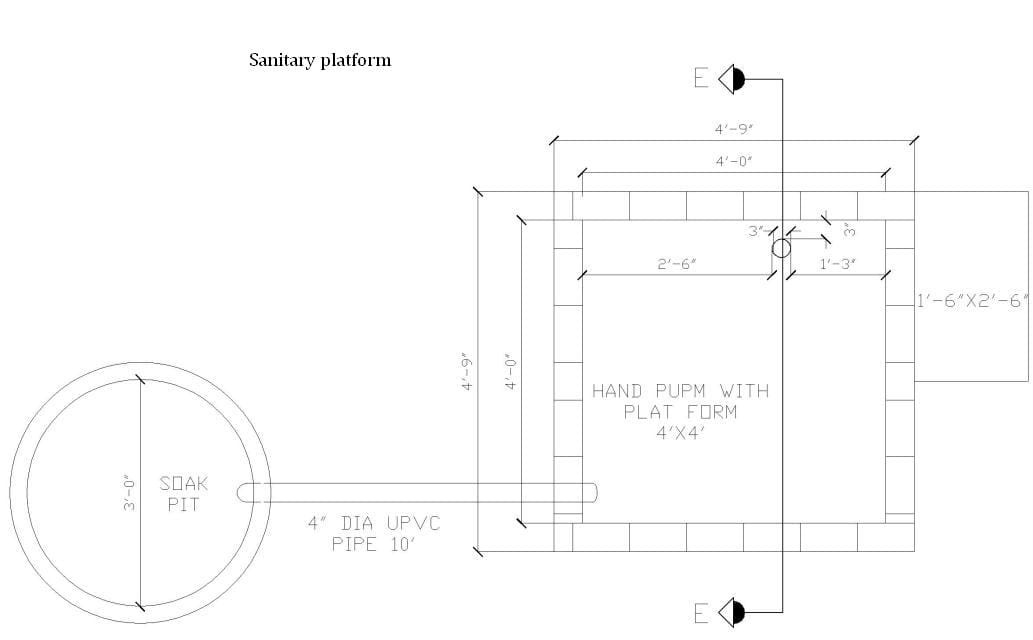
Sanitary platform is constructed with 4 feet x 4 feet or 5 feet x 6 feet (rectangular) or 5-6 feet dia (circular) cement concrete (CC) or reinforce cement concrete (RCC) platform. A waste water drainage system and a soak way is provided to cater for the drainage needs.
Design considerations
The key design features to be considered in this concept are:
- Great care to be taken in account while selecting the location of the borehole and its yield.
- The installation of a hand pump on poor location or yield of borehole can cause a problem, which might result in problems such as sand intrusion and silting.
- Quality control of both community construction and private contractors is essential
- The pump head is secured from contamination through installation of sanitary seal
- An additional non-return valve is placed on top of the well pipe head, while no non-return valve is used with traditional concept.
- Typically the pump and the horizontal pipeline will need to be primed before the first use, but following this no further priming should be necessary as the non-return valves will hold water in the pump and the horizontal pipeline.
- Suction hand pumps may lose the prime. Pumps losing the prime can come from a leak in the suction or extension line. The leaks must be found and repaired or else the pump will continue to lose the prime.
- If the Hand pump will not hold (prime) its level inside the pumping chamber the non returning valve or the lower check valve may be faulty
- The placement of Extension pipe (lead line) and the trench excavation be shortest possible straight lines
- Leadline Handpumps have also failed when reduction in the water table cause the dynamic water level to fall below the maximum suction capacity of the pump
- In some areas it is reported that pumps which initially supplied freshwater have become saline over time. This is most likely to be related to over pumping of the freshwater lens (which exists due to infiltration from the irrigation channel).
- Complete installation cost for new concept is much higher compared to traditional concept.
Field testing
The technology was introduced in late 2010 in Thatta district of Hyderabad, Sindh, Pakistan by Laar Humanitarian Development Programme (LHDP). Oxfam GB has successfully installed around 220 hand pumps in this area during November 2010 – February 2011,. Average borehole depth of these hand pumps varies from 40-50 feet (12-15m) and distance of the borehole from the village is between 500m – 1,500m.
In the year of 2009 in Bangladesh, during cyclone Aila response programme, nearly similar technology was introduced.
Future initiatives
Though this technology is successfully bringing water from a borehole located at 1,200 feet distance but its optimum capacity is yet to be explored.
Some organisations involved in construction of these systems have introduced additional non-return valves mid-way along the horizontal pipeline if the length of the leadline exceeds 150m (500’) but there is no evidence that this avoids operational problems.
Presently, dia 1.5 inch well pipe and dia 1.25 inch extension pipeline is used but the most favourable size for greater output or multiple connections is not found yet. Currently, single extension pipeline is connected to the wellhead while for multiple connections of extension pipeline and hand pump in different villages is yet to be discovered.
Layout
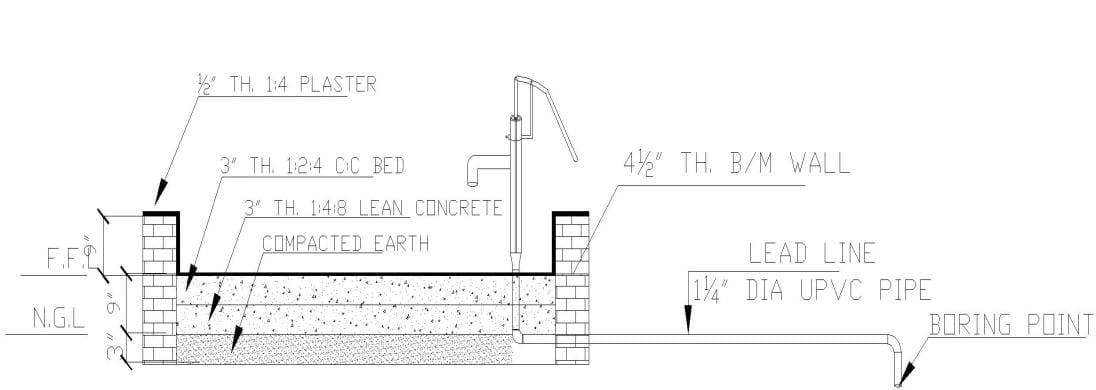
Further information
PHE Team, Humanitarian Department, Oxfam GB, Oxford, UK